Correct Piano Chord Fingering for Little Hands: Simple Troubleshooting Tips for Parents

Updated: Jul 15

One of the most exciting moments in Second Year Let's Play Music is when children begin playing chords on the piano. Instead of playing chords on the autoharp, they're learning to play three-note triads to create complete harmonies.
If you've already read our blog post, "Why Learning Chords Early Helps Children Succeed in Music Education," you know why chords are such an important part of your child's musical journey.
But once children begin playing chords, many parents start asking new questions.
"Why are my child's fingers flattening?"
"Are their hands too small?"
"Should I help move their fingers?"
If you've wondered any of these things, you're not alone! Keep reading!
The good news is that these challenges are completely normal. Learning chords is a brand-new skill, and little hands need time to develop the strength and coordination to play them comfortably.
Before we talk about hands and fingers, let's remember position and posture at the keyboard. Sitting at the correct height and distance from piano, keeping shoulders relaxed, and placing feet on the floor (or a footstool) gives children the stability and proper height so they can position hands comfortably and correctly.
Now let's look at what correct chord fingering looks like and some simple ways to support your young musician at home.
What Does Correct Chord Fingering Look Like?
Before children learn to play beautiful chords, they first learn how a relaxed hand should feel.
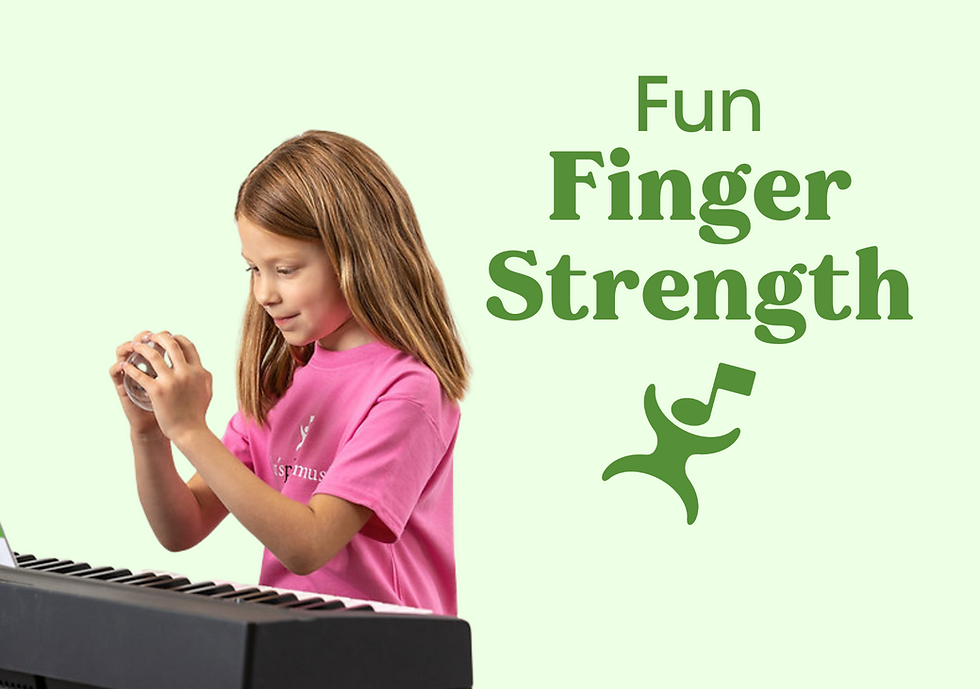
At Let's Play Music, we call this Bubble Hands.

Imagine your child gently holding a small bubble or a tiny ball. Their fingers naturally curve around it without squeezing. That's the same soft, rounded shape we want when they place their hands on the piano.
Bubble Hands help children:
play with curved fingers instead of flat ones
keep their wrists relaxed
use their fingertips instead of the flat part of their fingers
avoid unnecessary tension while playing
Don't expect perfect hand position every time. Children between the ages of five and seven are still growing, and developing good technique is a gradual process.
"My Child's Fingers Keep Flattening"
This is one of the most common challenges when children first learn chords.
Playing three notes at the same time asks several fingers to work together in a new way. Until those little muscles become stronger, fingers may flatten or collapse.
What helps?
Instead of correcting each finger individually, gently remind your child to make their Bubble Hands again.
One familiar reminder is usually much more encouraging than constant corrections.
As children continue singing, playing, and exploring music, those curved fingers gradually become natural.
"My Child Can't Reach All Three Notes"
Little hands come in all sizes.
Some children are ready to play a full chord right away, while others simply need more time for their hands to grow.
Rather than encouraging uncomfortable stretching, our teachers sometimes have students leave out the middle note and play only the two outside notes.
This keeps the hand relaxed while allowing children to experience success.
Healthy technique is always more important than forcing every note.
"My Child Takes a Long Time to Change Chords"
If your child pauses before every chord, don't worry.
Their brain is learning to recognize the chord, remember the hand shape, and move several fingers into place—all at the same time.
That's a big job for a young musician!
What helps?
At Let's Play Music, children first learn chord shapes with their right hand before adding the left.
Giving one hand time to learn first helps children build accurate muscle memory without feeling overwhelmed.
Even more exciting, researchers have found that once one hand learns a movement, the brain often helps the other hand learn it more quickly. This means children are already building skills for future success, even while practicing with one hand.
Sometimes slowing down helps children move forward more confidently.
"My Child Keeps Looking at Their Hands"
Almost every beginner looks at the keyboard. Children are still becoming familiar with where everything is, and that's perfectly normal. Before children can play confidently without looking, they first need to understand the keyboard.
That's why Let's Play Music includes fun activities like the Kit Kat Keyboard, helping children recognize the repeating groups of black keys and use them as landmarks.
As they become more familiar with the keyboard, they begin trusting their hands instead of relying only on their eyes.
Over time, you'll notice them spending more time looking at the music and less time looking down.
"Should I Move My Child's Fingers?"
Every parent wants to help.
When children hesitate, it's tempting to place their fingers on the correct keys.
Although it seems helpful, children actually learn more when they discover the movement themselves.
Each time they look at the music, think about the chord, and find it independently, they're strengthening important connections between their eyes, ears, brain, and hands.
Instead of moving your child's fingers, give them a few extra moments to think.
If a teacher needs to demonstrate, they may gently press the key instead of your child's finger. This allows the child to feel the key move naturally while still letting their own brain guide the motion.
Those moments of independent discovery build confidence that lasts.
Every Little Step Matters

Correct chord fingering isn't about making every chord perfect on the first try.
It's about helping children build healthy habits that will make playing easier and more enjoyable for years to come.
At Let's Play Music, we believe children learn best through joyful experiences, careful progression, and lots of encouragement.
So celebrate the little victories.
Celebrate Bubble Hands.
Celebrate smoother chord changes.
Celebrate growing confidence.
Those small successes are signs that your child is developing skills that will support a lifetime of music-making.
And remember—every confident pianist once started with little hands learning their very first chord.

This was a well-structured piece combining solid explanation with guidance that let me discover practical information immediately usable afterward. The author didn't overcomplicate things, keeping focus on exactly what readers actually needed to know here. That clarity made complex ideas feel far more manageable and easy to work with overall. Thanks for such a clear and genuinely valuable piece.
This piece did a wonderful job surfacing a counterintuitive finding that initially seemed wrong until the underlying reasoning was properly explained in detail. The author walked through the logic carefully, which turned my initial skepticism into genuine understanding by the time I'd finished reading it. That transformation is exactly what makes a discovery blog feel like a genuine act of learning rather than passive information consumption. Thanks for such a genuinely transformative and carefully explained piece.